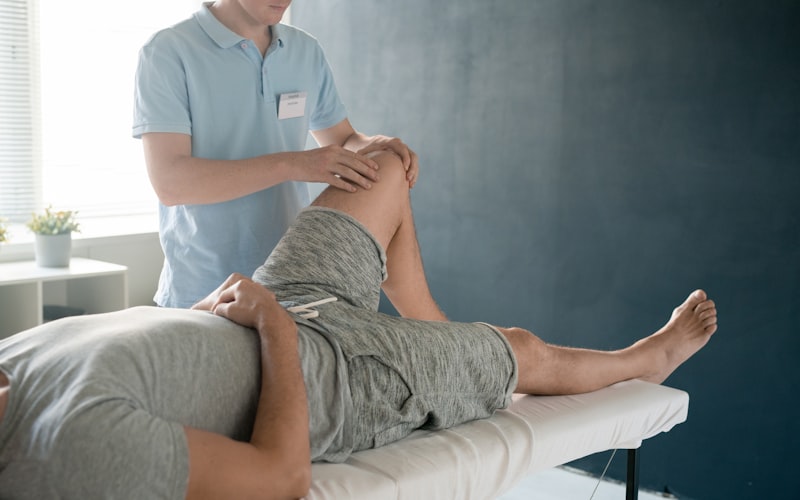
Hip and knee osteoarthritis can limit your independence. While chiropractic care can't reverse cartilage loss, it can significantly reduce pain, improve joint function, and slow degeneration by optimizing alignment and movement patterns.
Quick answer: Dr. Steven Bromberg treats hip & knee osteoarthritis at 201 Broadway, Cambridge, MA. Same-week appointments, no referral needed, most major insurance and Massachusetts auto PIP accepted. Call (617) 494-1166.
40+ Years
Doctor-Led
Evidence-Based
Insurance Accepted
Same-Day Available
Understanding Hip & Knee Osteoarthritis
Hip and knee osteoarthritis can limit your independence. While chiropractic care can't reverse cartilage loss, it can significantly reduce pain, improve joint function, and slow degeneration by optimizing alignment and movement patterns.
Common Symptoms
Joint stiffness especially after restPain worsening with activityGrinding or crunching sensationReduced range of motionSwelling around the joint
Hip & Knee Osteoarthritis at 201 Broadway, Cambridge
What Causes Hip and Knee Osteoarthritis
Osteoarthritis is the gradual wearing of the cartilage that caps the ends of the bones in a joint. As the cartilage thins, the bone beneath it thickens and forms spurs at the edges, the joint lining becomes irritated and produces more fluid, and the muscles around the joint weaken and tighten in response to pain. The hip and knee carry body weight with every step, which is why they are the joints most often affected.
Age is the biggest factor and the one nobody controls. The others are more workable. Previous injury is a major one: a meniscus tear or ligament injury in your 20s raises the odds of knee arthritis in your 50s, and a hip that never developed quite the right shape wears faster. Body weight multiplies the load on the knee several times over with each stride. Alignment matters; bowed or knock-kneed legs load one side of the joint more than the other. Family history plays a role. And joints that are not used stiffen and lose the nutrition that movement pumps into cartilage, which is why long stretches of sitting at a Kendall Square desk make an arthritic knee feel worse at the end of the day than a walk along the Charles would.
The pattern of symptoms is characteristic. Stiffness after rest that loosens in the first few minutes of moving. Pain that builds with activity and eases with rest. A grinding or crunching sensation. Hip arthritis often shows up as groin pain rather than pain at the side of the hip, and sometimes as knee pain with nothing wrong at the knee. Knee arthritis makes stairs, especially coming down, and getting up from a low chair the hardest tasks. Boston winters are not kind to either; cold stiffens the tissue and ice changes how carefully people walk.
One honest point to make up front: cartilage that has worn away does not grow back, and nothing we do here reverses that. What can be changed is how much pain the joint produces, how well it moves, how strong the muscles supporting it are, and how fast the wear progresses from here. That turns out to be a lot.
How We Diagnose It at 201 Broadway
Dr. Bromberg takes the history himself. He asks where exactly it hurts, how it behaves through the day, what it stops you doing, whether there was an old injury, what has already been tried, and what your goals are, because the plan for someone who wants to keep hiking the Middlesex Fells is different from the plan for someone who wants to get through a workday without limping.
The exam looks at the joint and at everything that loads it. He measures hip and knee range of motion and compares sides; loss of internal rotation at the hip is one of the earliest signs of hip arthritis. He checks for swelling, warmth and tenderness along the joint line, tests the stability of the knee ligaments, and assesses the strength of the quadriceps, the hip abductors and the gluteals, which are almost always weak in a long-standing arthritic joint. He then watches you walk, stand on one leg, rise from a chair and, if you can, squat. That gait and posture analysis shows him how you have adapted to the joint and where the extra load is going: the low back, the opposite hip, the ankle.
The low back is examined on every hip and knee patient. Lumbar nerve roots refer pain into the hip, thigh and knee, and sacroiliac joint problems mimic hip arthritis closely. A neurological screen of reflexes, sensation and strength in the legs is included whenever there is numbness, tingling or pain that travels.
X-rays are useful in osteoarthritis because they show the joint space, the spurs and the alignment, and they establish a baseline. If you have recent films, bring them; if not, he refers you to an area imaging center and reviews the results with you. MRI is reserved for a joint that locks or gives way, suspected meniscus or labral tears in a patient who may be a surgical candidate, or a hip that may have avascular necrosis. He is separating true joint arthritis from referred spinal pain, from tendon and bursa problems around the hip and knee, and from meniscus or labral tears that would change the plan.
How We Treat Hip and Knee Osteoarthritis
The goal is a joint that hurts less, moves better and is supported by stronger muscle, in a body that loads it more evenly. Every part of the plan serves one of those.
Adjustments and joint mobilization restore motion to the arthritic joint within the range it still has, and to the joints around it. For the hip and knee that means gentle, low-force mobilization rather than high-velocity manipulation; the arthritic joint is treated with respect for its condition. The sacroiliac joints, the lumbar spine, the ankle and the foot are adjusted as needed, because stiffness there sends more load through the knee and hip with every step. Patients are often surprised at how much a stiff ankle contributes to knee pain, or a stiff low back to hip pain.
Soft tissue work addresses the muscles that have tightened around the joint. The hip flexors, the IT band and the adductors around an arthritic hip, and the quadriceps, hamstrings and calf around an arthritic knee, shorten with disuse and guarding. Releasing them with Active Release Technique restores range and takes pressure off the joint surfaces.
Rehab is where the long-term benefit lives, and it is the part most patients have been told about but never actually been shown. Strong quadriceps and hip abductors measurably reduce knee pain and protect the joint. Dr. Bromberg prescribes a home program built around what you can tolerate, and progresses it as the joint allows. Clinical guidelines consistently list exercise and weight management as first-line care for hip and knee osteoarthritis, ahead of injections and surgery.
The first visit is the longest: history, the full joint, spine and gait exam, a review of any imaging you have, a plain explanation of what Dr. Bromberg found and what he thinks can and cannot be changed, and usually a first treatment the same day. Bring your X-ray or MRI reports, a list of your medications, and the shoes you walk in most. No referral is needed.
Follow-ups are shorter and focused on motion, strength and function. He rechecks range of motion, treats the joint and the surrounding tissue, and advances the home program. Osteoarthritis care typically starts at once or twice a week for four to six weeks, which is usually long enough to know how much the joint is going to respond. From there, many patients move to a maintenance schedule, perhaps once a month or once every few weeks, that keeps the gains in place. That schedule is set by how the joint behaves between visits, not by a package. We do not sell prepaid plans; care is reassessed on real progress.
Progress is measured in things that matter. Range of motion in degrees. How many stairs before the knee complains. How long you can walk. Whether you can get up from a chair without using your arms. How you sleep. He compares these against the first-visit baseline at regular intervals, and if they are not improving, the plan changes.
Dr. Bromberg has treated arthritic hips and knees in Cambridge for more than 40 years, and he sees every patient personally at every visit. The office is on the first floor of 201 Broadway with no stairs at the entrance, with free and metered parking on Broadway and the side streets for patients who do not want to walk from the Red Line.
What to Expect: Outcomes and Timelines
Osteoarthritis is a long-term condition, and the expectations need to be stated plainly. Most patients notice less stiffness and easier movement within the first few weeks. Pain with activity usually improves over six to twelve weeks as the muscles strengthen and the joint mechanics improve. The joint will not be twenty years younger, but it will often be a joint you can live and walk with comfortably, and that is the realistic target.
What slows progress: body weight that is not addressed, a home program that is not done, long periods of sitting, a job or sport that overloads the joint without modification, and the belief that a painful joint should be rested completely. Rest beyond a flare makes arthritis worse. Advanced disease with bone touching bone responds less than early and moderate disease, which is a strong argument for coming in before the X-ray looks terrible.
The plan changes when the joint stops responding. Dr. Bromberg re-examines, updates imaging if it is more than a year or two old, and refers when that is the right call. He refers to an orthopedic surgeon when there is significant joint space loss with pain that is not controlled by conservative care, when the joint locks or gives way from a mechanical tear, when night pain and function have declined to the point that a replacement would likely give a better quality of life, or when you want a surgical opinion. He refers to a rheumatologist when the pattern suggests an inflammatory arthritis rather than wear. He will tell you honestly when he thinks you are a replacement candidate rather than stretching out care that is not changing the picture.
For patients who do go on to a joint replacement, the strength and motion built beforehand carry over; a joint that goes into surgery stronger comes out of it faster. And many patients who come in expecting to need surgery find that a stronger, better-moving joint pushes that decision years down the road or off the table.
When to See Someone Else First
Some hip and knee symptoms are not osteoarthritis and need a different office first. Go to urgent care, the emergency room or your physician before coming here if you have:
A hot, red, swollen joint, especially with fever or feeling unwell, which can be a joint infection or gout and needs same-day medical care
Sudden inability to bear weight after a fall, or hip pain after a fall in anyone over 65 or with osteoporosis, which may be a fracture even if you can still stand
A knee that locks and cannot be straightened, or a joint that gives way repeatedly
Calf pain with swelling, warmth or redness in one leg, which can be a blood clot
Deep groin or hip pain that came on quickly in a patient taking long-term steroids or with heavy alcohol use, which can be avascular necrosis
Numbness, tingling or weakness spreading down the leg that is getting worse, or any change in bowel or bladder control
Unexplained weight loss, night pain that does not change with position, or a history of cancer
Once those have been ruled out, hip and knee osteoarthritis is one of the conditions where early, consistent conservative care makes the most difference, and the joint does not improve by waiting. Call (617) 494-1166 or walk in on Monday, Wednesday or Friday during office hours. Same-day slots are held for patients in pain.
of patients describe chiropractic care as "very effective"
Gallup-Palmer Survey
#1
recommended non-surgical treatment for back pain
American College of Physicians
95%
of past-year chiropractic users say it is effective
Gallup-Palmer College of Chiropractic
Your Doctor
Dr. Steven J. Bromberg
For over 40 years, Dr. Bromberg has provided chiropractic care in Cambridge, MA. He personally evaluates and treats every patient, combining adjustments, muscle therapy, and modern technology for lasting results.
"Dr. Bromberg found the root cause of my lower back pain on my first visit. After three adjustments, I felt like a new person. 40 years of experience really shows."
David R.
Lower back pain, 3 sessions
★★★★★
"I was in a car accident and thought I'd need surgery. Dr. Bromberg's rehab program got me back to normal without a single operation. The insurance paperwork was painless too."
Maria S.
Auto accident whiplash recovery
★★★★★
"The Active Release Technique on my shoulder was remarkable. Years of frozen shoulder pain resolved in about six sessions. I can finally sleep on my side again."
Yes. While it can't reverse cartilage loss, chiropractic adjustments improve joint mechanics, reduce compensatory strain, and manage pain. This often delays or avoids joint replacement.
Yes. Dr. Bromberg uses gentle techniques appropriate for arthritic joints, focusing on maintaining mobility and reducing inflammation.
No. Beyond a short flare, rest makes an arthritic joint stiffer and the muscles around it weaker. Clinical guidelines list exercise as first-line care. Dr. Bromberg helps you find the activities and the dose the joint tolerates, which for most patients includes walking, cycling or swimming.
If you have recent films, bring the report. If not, Dr. Bromberg will usually refer you for standing X-rays of the joint after the exam, because they show joint space and alignment and give a baseline to compare against later. He reviews the results with you.
For many patients, yes, by improving strength, motion and mechanics enough that the joint is comfortable to live with. It does not regrow cartilage, and for a joint that is bone on bone with constant pain, replacement may be the better answer. Dr. Bromberg will tell you honestly which situation you are in.
Steroid and hyaluronic acid injections can reduce pain for a period and are compatible with the work we do; they treat the symptom while we work on the mechanics and strength. Evidence for glucosamine and similar supplements is mixed. Neither replaces the exercise program.
The hip commonly refers pain to the front of the thigh and the knee, and a knee that examines normally with a stiff, painful hip is a familiar picture. The exam at your first visit sorts out which joint is actually producing the pain so the treatment goes to the right place.