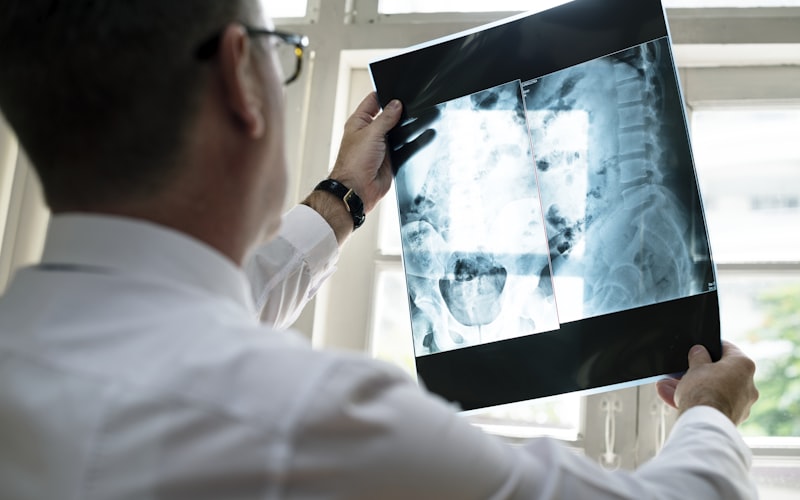
When your condition calls for diagnostic imaging (X-rays, MRI, or CT scans), we coordinate referrals to imaging centers in the area. Dr. Bromberg reviews all results personally to make sure your treatment plan is based on an accurate diagnosis.
Quick answer: Dr. Steven Bromberg treats imaging & referral services at 201 Broadway, Cambridge, MA. Same-week appointments, no referral needed, most major insurance and Massachusetts auto PIP accepted. Call (617) 494-1166.
40+ Years
Doctor-Led
Evidence-Based
Insurance Accepted
Same-Day Available
Imaging & Referral Services
When your condition calls for diagnostic imaging (X-rays, MRI, or CT scans), we coordinate referrals to imaging centers in the area. Dr. Bromberg reviews all results personally to make sure your treatment plan is based on an accurate diagnosis.
How It Works
How Imaging & Referral Services Works
Based on your examination, Dr. Bromberg determines if imaging is needed and refers you to the right facility. He reviews all results himself and uses the findings to guide your treatment. If your condition needs specialist care beyond chiropractic, he arranges referrals to physicians he trusts.
Benefits
Benefits of Imaging & Referral Services
Coordinated referrals to local imaging centers
Dr. Bromberg personally reviews all results
Accurate diagnosis guides your treatment plan
Smooth referrals to specialists when needed
Conditions Treated
Imaging & Referral Services Treats These Conditions
Imaging & Referral Services at 201 Broadway, Cambridge
How We Handle Imaging and Referrals in Cambridge
We do not have an X-ray machine, an MRI or a CT scanner in the office. When imaging is needed, Dr. Bromberg writes the order and refers you to an imaging center or hospital radiology department in the Cambridge and Greater Boston area. The images and the radiologist's report come back to him, he reviews them himself, and he goes over them with you. That is the whole service, and it is worth being plain about, because some patients expect a scan at the first visit and are surprised when they do not get one.
Most patients do not need imaging before starting care. For back and neck pain without warning signs, clinical guidelines from the American College of Physicians and others recommend against routine imaging in the first weeks, because it does not change the treatment and often turns up findings that have nothing to do with the pain. MRI scans of adults who have no back pain at all regularly show disc bulges and degenerative changes. A finding on a scan only means something once it matches what the examination found. After more than 40 years in practice, Dr. Bromberg has seen plenty of alarming reports attached to backs that got better in three weeks, and plenty of clean reports attached to people who were in real trouble. The exam comes first.
He does order imaging in specific situations. When there has been significant trauma, such as a fall or a car accident with a mechanism that could fracture bone. When there is a history of osteoporosis and new pain. When there is a cancer history, unexplained weight loss, fever or night pain. When there is weakness, numbness or reflex change that is progressing. When a reasonable trial of care, typically four to six weeks, has not produced the progress it should. When the exam suggests a disc problem that needs to be confirmed before committing to spinal decompression. And when a structural question, such as a spinal curve or a suspected instability, would change how he treats you.
Which study depends on the question. X-ray shows bone: fractures, alignment, arthritis, curves, bone spurs. MRI shows soft tissue: discs, nerve roots, the spinal cord, ligaments, and it is the study for disc injuries and sciatica that is not responding. CT shows bone in fine detail and is used when fracture detail matters or when MRI is not possible. He orders the one that answers the question, not all three.
Referrals work the same way. When something is outside chiropractic scope, he sends you to the right person: an orthopedist, a neurologist, a pain management physician, a rheumatologist, or back to your primary care doctor, with his notes and the imaging attached so nobody starts from zero.
What Your Visits Look Like
The first visit is the same whether or not imaging ends up being part of your care: a health history, a physical exam with orthopedic and neurological testing as needed, and a treatment plan. If the exam shows no warning signs, treatment usually starts the same day and imaging is not discussed further unless progress stalls.
If the exam does call for imaging, Dr. Bromberg writes the order that day and explains what he is looking for. Our front desk helps you find a center that takes your insurance and is convenient; several are a short trip from Kendall Square. You schedule the study directly with the center. X-rays are often quick to arrange. MRI can take longer, both to get an appointment and because many insurance plans require prior authorization before they will pay for it. In most cases he starts gentle, safe treatment while the imaging is pending; when the exam says it is not safe to treat until the pictures are back, he waits.
If you already have imaging from another provider, bring it. A copy of the report is useful; access to the actual images, on a disc or through a patient portal, is better. He reviews prior imaging at your first visit, and a scan that is a year or two old is often still relevant.
Once results are in, a follow-up visit is spent going through them. He shows you what the radiologist found and, just as important, what it means for you and what it does not mean. A bulging disc on a report is not a surgical sentence. The treatment plan is adjusted to match, which might mean continuing as planned, changing technique, adding decompression, or a referral.
Imaging does not add a course of visits. It adds one order, one trip to a center, and one conversation. After that, progress is measured by the examination and by what you can do, not by repeat scans. He rarely re-images unless something changes.
What to Expect: Results and Timelines
The useful thing to understand about imaging is what it can and cannot tell you. It shows structure. It does not show pain. Two people can have identical MRI reports and one is running marathons while the other cannot get out of a chair. That is why Dr. Bromberg treats the person in front of him and uses the scan to confirm or rule out specific things, rather than treating the report.
Timelines depend on the study and the center. X-ray results usually come back within days. MRI can take longer to schedule, and prior authorization can add time if your plan requires it. What slows things down most is avoidable: choosing a center across town because it was the first one you found, forgetting to bring prior records, or waiting to book the study. Our front desk can take some of that off your plate.
If the imaging shows something that chiropractic care cannot address, he tells you directly and arranges the referral. He refers to the emergency department, not to a specialist's waiting list, for the serious findings: a suspected fracture that needs immediate care, signs of infection or tumor, or any combination of back pain with new bowel or bladder change or numbness in the saddle area, which can mean cauda equina syndrome. Our post on back pain red flags spells these out.
For the non-emergency findings, the referral goes to the right office. A large disc extrusion with progressing weakness goes to a spine surgeon for an opinion, which is not the same as a recommendation for surgery; most herniated discs are treated without it. Severe stenosis with neurological change goes to a specialist. Inflammatory findings go to rheumatology. In every case he sends his notes and stays involved, and many patients come back to continue care alongside the specialist.
Who It Is For, and Who It Is Not For
Imaging is for the patient whose exam raises a specific question that a picture can answer. That includes people with significant trauma, people with the warning signs listed above, people with nerve symptoms that are progressing, people who have had a fair trial of care without the expected progress, and people being considered for spinal decompression where the disc needs to be confirmed. It is also for anyone who arrives with a confusing history and conflicting prior opinions, where a clean set of images settles the question.
It is not for the patient who wants a scan to see what is in there. Dr. Bromberg will not order imaging that would not change the plan, and he will explain why, because an unnecessary scan costs money, can delay care, and sometimes produces a frightening report about something that was never the problem. If you are not comfortable starting without a picture, say so, and he will walk you through what the exam found and why he is confident proceeding.
A few practical limits. MRI is not possible for some patients with pacemakers or certain metal implants; CT or X-ray may be used instead, and the center screens for this. X-ray is avoided in pregnancy, and pregnancy care here is exam-based with gentle techniques. If you cannot tolerate lying still in a scanner, tell us and we will look for a center with an open-sided or wide-bore machine.
Cost, Insurance and Booking
Imaging is billed by the imaging center, not by our office. Your health plan's imaging benefit, deductible and prior authorization rules apply, and the center can tell you your expected cost before you go. We help on our end by writing the order, confirming the center is in your network, and sending the paperwork. After a car accident, Personal Injury Protection on your own auto policy covers reasonable medical care including imaging and chiropractic, regardless of fault, with a statutory minimum of $8,000 per person; see our auto accident coverage page.
Our own visits are billed per visit, with no prepaid packages. Most major insurance plans are accepted, and we verify your specific benefits before treatment so you know what you owe. The insurance page explains the process.
No referral is needed to see Dr. Bromberg; Massachusetts allows direct access to chiropractic care. Walk-ins are welcome during office hours, same-day slots are held for people in pain, and if you call (617) 494-1166 we can usually see you the same week. Hours are Monday, Wednesday and Friday, 8am to 1pm and 3pm to 6pm. The office is at 201 Broadway, first floor, a six-minute walk up Broadway from the Kendall/MIT Red Line station and about ten minutes from Lechmere, with free street parking and metered parking on Broadway and the side streets. The new patient page covers what to bring, including any prior imaging.
of patients describe chiropractic care as "very effective"
Gallup-Palmer Survey
#1
recommended non-surgical treatment for back pain
American College of Physicians
95%
of past-year chiropractic users say it is effective
Gallup-Palmer College of Chiropractic
Your Doctor
Dr. Steven J. Bromberg
For over 40 years, Dr. Bromberg has provided chiropractic care in Cambridge, MA. He personally evaluates and treats every patient, combining adjustments, muscle therapy, and modern technology for lasting results.
"Dr. Bromberg found the root cause of my lower back pain on my first visit. After three adjustments, I felt like a new person. 40 years of experience really shows."
David R.
Lower back pain, 3 sessions
★★★★★
"I was in a car accident and thought I'd need surgery. Dr. Bromberg's rehab program got me back to normal without a single operation. The insurance paperwork was painless too."
Maria S.
Auto accident whiplash recovery
★★★★★
"The Active Release Technique on my shoulder was remarkable. Years of frozen shoulder pain resolved in about six sessions. I can finally sleep on my side again."
Dr. Bromberg may recommend imaging when the physical exam suggests a fracture, severe disc injury, or something that needs visualization for an accurate diagnosis.
We refer to imaging centers in the Cambridge and Greater Boston area. We handle the coordination to make it easy.
Most insurance plans cover medically necessary imaging. Our team can help verify your coverage.
Yes. Bring the report and, if you can, the images on a disc or through your patient portal. Dr. Bromberg reviews prior imaging at your first visit and will not repeat a study that already answers the question. A scan that is a year or two old is often still useful.
Because for most back and neck pain it would not change what we do, and because we do not have an X-ray machine on site. Clinical guidelines recommend against routine imaging in the first weeks of uncomplicated spine pain. If your exam shows a reason for imaging, he orders it that day. If it does not, the exam is the better guide.
Dr. Bromberg can order X-ray, MRI and CT directly. Some insurance plans require prior authorization or prefer the order to come from your primary care physician; we check your plan before you schedule, and when a plan insists on a physician order we coordinate with your doctor rather than leaving you to sort it out.
Almost never on its own. Disc bulges are common in people with no pain at all, and most painful disc problems improve with conservative care. Surgery becomes a conversation when there is progressing weakness, bowel or bladder change, or pain that has not responded to a proper course of non-surgical treatment. He will tell you honestly which situation you are in.
Usually, yes. When the exam shows no warning signs, he begins gentle treatment while the imaging is pending and adjusts the plan once the results are in. When the exam suggests something that makes treatment unsafe until it is ruled out, such as a possible fracture, he waits for the pictures and says so.