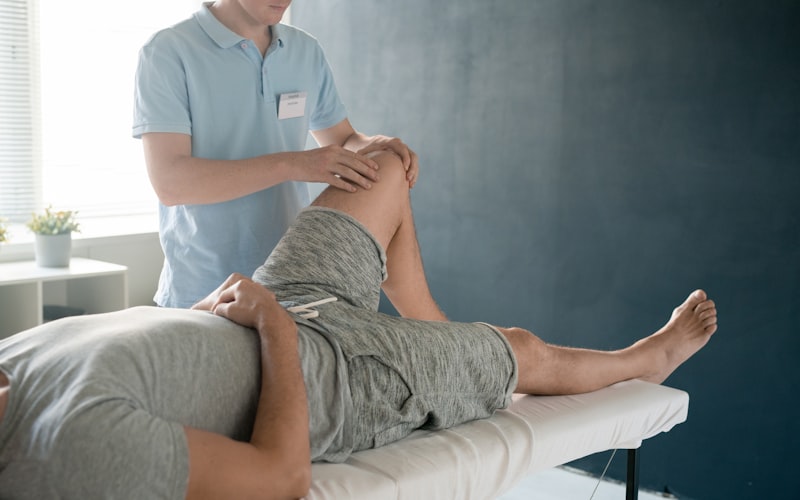
Knee and wrist pain can stem from local injury or from compensatory patterns elsewhere in the body. Dr. Bromberg evaluates the full kinetic chain to find and fix the true cause.
Quick answer: Dr. Steven Bromberg treats knee & wrist pain at 201 Broadway, Cambridge, MA. Same-week appointments, no referral needed, most major insurance and Massachusetts auto PIP accepted. Call (617) 494-1166.
40+ Years
Doctor-Led
Evidence-Based
Insurance Accepted
Same-Day Available
Understanding Knee & Wrist Pain
Knee and wrist pain can stem from local injury or from compensatory patterns elsewhere in the body. Dr. Bromberg evaluates the full kinetic chain to find and fix the true cause.
Common Symptoms
Pain during gripping or typingKnee pain going up/down stairsSwelling or stiffnessClicking or lockingReduced grip strength
Knee and wrist pain share a feature that makes them worth treating together: both joints sit in the middle of a chain, and both take the blame for problems that start somewhere else.
At the knee, the most common complaint we see at 201 Broadway in people under 50 is pain at the front of the knee around or under the kneecap, often called runner's knee or patellofemoral pain. It is worse on stairs, after sitting with the knee bent, and with squatting. The kneecap is tracking slightly off center in its groove, and the reason is almost always above or below it: a weak hip that lets the thigh roll inward, a tight IT band or quadriceps, a stiff ankle, or a foot that collapses on landing. Runners who add mileage on the Charles River loop too quickly, cyclists with a saddle set too low, and anyone starting a squat program at a Kendall Square gym produce it reliably. Other knee problems include patellar tendinopathy, IT band friction at the outside of the knee, pes anserine bursitis on the inside, and meniscus irritation in people over 40. Knee pain in a patient whose knee examines normally is sometimes a hip or a lumbar nerve root problem.
At the wrist, the overwhelming driver is repetitive load in a fixed position. Eight to ten hours a day at a keyboard and mouse in a Kendall Square office or a lab bench, with the wrist bent back and the forearm muscles working in a short range, inflames the tendons that cross the wrist and compresses the median nerve where it passes through the carpal tunnel. Carpal tunnel syndrome produces numbness and tingling in the thumb, index and middle fingers, worse at night. De Quervain's tenosynovitis is pain at the thumb side of the wrist from the tendons that lift the thumb, common in new parents and in anyone who texts and scrolls heavily. Wrist sprains from a fall on an outstretched hand, on winter ice or off a bike, are the main acute injury. And wrist and hand symptoms are often not from the wrist at all: a pinched nerve in the neck, or nerve compression at the elbow or under a tight muscle in the forearm, produces the same numbness and is missed when only the wrist is examined.
How We Diagnose It at 201 Broadway
Dr. Bromberg takes the history himself. For the knee: where exactly it hurts, whether stairs, sitting or squatting provoke it, whether it swells, locks or gives way, what changed in training or activity before it started, and any prior injury. For the wrist: which fingers go numb, whether it wakes you at night, whether shaking the hand out helps, what your workstation looks like, what you do with your hands all day, and whether there is any neck pain or symptoms in the other arm.
The knee exam looks at the joint and the chain. He checks for swelling and warmth, feels along the joint line, the patellar tendon and the soft tissue on both sides, tests the stability of the ligaments and the meniscus, and watches how the kneecap tracks as the knee bends. Then he tests hip abductor and gluteal strength, measures ankle motion, looks at the arch of the foot, and watches you walk, step down and do a single leg squat. The single leg squat tells him more about most knee pain than any image: if the knee dives inward, the problem is hip control and that is what gets treated.
The wrist exam starts with the neck. He checks cervical range of motion and runs a neurological screen of reflexes, sensation and strength in the arm, because a cervical nerve root produces numbness in the same fingers as carpal tunnel. He then checks the elbow and forearm for nerve compression sites, examines the wrist itself with the standard carpal tunnel and tendon tests, measures grip strength on both sides, and looks at how you hold a mouse and keyboard.
Imaging is ordered when it would change the plan. A knee X-ray after an acute injury, for suspected arthritis, or in older patients; a knee MRI for a joint that locks, gives way or has significant swelling, where a meniscus or ligament tear would need an orthopedic opinion. A wrist X-ray after a fall, since a scaphoid fracture is easy to miss and important to catch. Nerve conduction studies are arranged through a neurologist when carpal tunnel is severe, when there is muscle wasting at the base of the thumb, or when the source of the nerve symptoms is unclear. He refers to area imaging centers and reviews the results with you himself.
How We Treat Knee and Wrist Pain
Treatment goes to the cause, which is rarely only the painful joint.
For the knee, Active Release Technique releases the tight structures that are pulling the kneecap off its track or overloading the tendon: the lateral quadriceps, the IT band and the muscles that feed into it, the hamstrings and the calf. Adjustments restore motion where it has been lost, most often at the ankle, the sacroiliac joints and the hip, and occasionally at the small joints of the knee itself, mobilized gently. The rehab is specific: hip abductor and gluteal strengthening, quadriceps work in ranges that do not provoke the kneecap, and a loading program for a tendon problem. For runners he adjusts training volume and sometimes stride mechanics, and for cyclists he checks saddle height.
For the wrist, ART is applied to the forearm flexors and extensors that have adhered from repetitive work, to the pronator teres where the median nerve can be trapped in the forearm, and across the carpal tunnel itself. The small bones of the wrist are mobilized to restore their glide. Where the neck is contributing, which it often is in desk workers, the cervical and upper thoracic spine are adjusted and the nerve is given room at its source. Nerve gliding exercises and forearm stretching are taught for home. A night splint that holds the wrist neutral is often recommended for carpal tunnel because most of the compression happens while you sleep with the wrist curled.
Workstation changes are part of the plan for nearly every wrist patient and many knee patients. Monitor height, keyboard position, mouse choice, and for standing desks the position of the elbows, all change the load on the wrist and the neck. Dr. Bromberg will go through your setup with you. Our post on carpal tunnel and wrist pain treatment covers the wrist side in more depth, and the desk worker's guide covers the setup.
What Your Visits Look Like
The first visit covers the history, the full chain exam described above, a neurological screen where there are nerve symptoms, a clear explanation of what Dr. Bromberg thinks is driving the pain, and usually a first treatment the same day. For knee pain, wear or bring shorts and your usual shoes. For wrist pain, a photo of your desk setup is useful. Bring any imaging or nerve study reports. No referral is needed.
Follow-ups are shorter and focused on the measurements that matter. He rechecks tenderness, strength and range, treats with ART and adjustments as indicated, and advances the home program. Patellofemoral and tendon problems at the knee are typically seen once or twice a week for four to eight weeks. Carpal tunnel and wrist tendon problems run a similar span, with milder cases resolving faster and long-standing nerve compression taking longer. A fall-related sprain is seen more often in the first two weeks while it is changing fast. Dr. Bromberg sees every patient at every visit personally.
Progress is measured in function. For the knee: how many stairs, how far you can run or how long you can sit without the knee complaining, whether the single leg squat has straightened out. For the wrist: grip strength in both hands, how many nights you sleep through without numbness, how long you can type before symptoms begin. He compares against the first-visit baseline at set intervals. If the numbers are not moving, the plan changes. We do not sell prepaid packages; care is reassessed on real progress.
We are a 6-minute walk from the Kendall/MIT Red Line station and about 10 minutes from Lechmere, with free and metered street parking on Broadway. Same-day slots are held for patients in pain.
What to Expect: Outcomes and Timelines
Patellofemoral pain usually improves noticeably in three to four weeks once the hip is doing its job and the tight tissue has been released, and resolves over six to ten weeks with the home program. Patellar and other tendon problems are slower, commonly eight to twelve weeks, because tendon remodels slowly. Mild to moderate carpal tunnel often improves within a few weeks when the workstation, the forearm and the neck are all addressed, with night symptoms usually the first to go. Severe carpal tunnel with constant numbness or muscle wasting is less predictable and may need a surgical release; the exam at your first visit tells Dr. Bromberg which group you are in, and he will say so.
What slows recovery: continuing the aggravating activity at full volume, skipping the hip exercises or the nerve glides, a workstation that is never actually changed, a neck contribution that goes untreated, and waiting many months before being evaluated. A kneecap that has tracked poorly for two years has usually irritated the cartilage beneath it, and that settles more slowly than one seen in the first few months. A median nerve compressed for a year recovers more slowly than one compressed for two months.
The plan changes when the evidence says it should. If a problem that should be improving is not, Dr. Bromberg re-examines, orders imaging or nerve studies that were not needed at the start, and refers when that is the right call. He refers to orthopedics for a meniscus tear that locks the knee, a ligament tear with instability, a tendon rupture, a suspected scaphoid fracture, and for carpal tunnel that is severe or not responding to conservative care, where a release is a reliable operation. He refers to a neurologist when the source of nerve symptoms is unclear. He coordinates with hand therapists and physical therapists when a patient benefits from more supervised time than one office provides.
The realistic goal is a knee that handles stairs and running without complaint, or a hand that works a full day and sleeps a full night, with the cause corrected so it does not come back the next time the mileage or the deadline goes up.
When to See Someone Else First
Some knee and wrist problems belong in urgent care, the emergency room or an orthopedic office before they belong here. Go there first if you have:
A fall onto the hand with pain and tenderness at the base of the thumb, which can be a scaphoid fracture that does not always show on the first X-ray
A visible deformity of the wrist or knee, or a joint you cannot move after an injury
Inability to bear weight on the leg for four steps right after a knee injury, or rapid large swelling within an hour or two
A knee that is locked and cannot be straightened
A hot, red, swollen knee or wrist, especially with fever, which can be a joint infection or gout
Numbness that is constant rather than intermittent, visible wasting of the muscle at the base of the thumb, or weakness that is getting worse, which mean nerve compression is advanced and needs prompt evaluation
Numbness or weakness in both hands or both legs, or any change in bowel or bladder control, which point to the spinal cord rather than a peripheral problem
Calf pain with swelling, warmth or redness, which can be a blood clot
Once a fracture, full tear, infection or advanced nerve injury has been ruled out, most of what remains is a tracking, loading or compression problem, and those respond to the work we do, especially when they are seen early. Call (617) 494-1166 or walk in Monday, Wednesday or Friday during office hours.
of patients describe chiropractic care as "very effective"
Gallup-Palmer Survey
#1
recommended non-surgical treatment for back pain
American College of Physicians
95%
of past-year chiropractic users say it is effective
Gallup-Palmer College of Chiropractic
Your Doctor
Dr. Steven J. Bromberg
For over 40 years, Dr. Bromberg has provided chiropractic care in Cambridge, MA. He personally evaluates and treats every patient, combining adjustments, muscle therapy, and modern technology for lasting results.
"Dr. Bromberg found the root cause of my lower back pain on my first visit. After three adjustments, I felt like a new person. 40 years of experience really shows."
David R.
Lower back pain, 3 sessions
★★★★★
"I was in a car accident and thought I'd need surgery. Dr. Bromberg's rehab program got me back to normal without a single operation. The insurance paperwork was painless too."
Maria S.
Auto accident whiplash recovery
★★★★★
"The Active Release Technique on my shoulder was remarkable. Years of frozen shoulder pain resolved in about six sessions. I can finally sleep on my side again."
Yes. Knee pain often involves misalignment of the hip, pelvis, or foot that changes knee mechanics. Correcting the chain resolves the knee pain.
Chiropractic care and ART address the nerve compression that causes carpal tunnel symptoms, often without surgery.
Coming down loads the kneecap against its groove with the quadriceps working while lengthening, which multiplies the pressure under the patella. Pain that is worse descending is a classic sign of a patellofemoral tracking problem, and it usually improves when the hip muscles that control the thigh are strengthened.
Often, especially if it is the thumb, index and middle fingers and shaking the hand out helps. But a pinched nerve in the neck and nerve compression at the elbow produce similar symptoms, and the exam at your first visit checks all three sites before deciding where to treat.
A rigid brace during the day usually makes typing more awkward without fixing the cause. A neutral night splint is different; it stops the wrist curling in sleep, which is when most carpal tunnel compression happens, and it is often recommended as part of the plan.
We will go through it with you. Monitor height, keyboard and mouse position, chair height and elbow angle all change the load on the wrist and neck. Bring a photo of your workstation to the first visit and Dr. Bromberg will tell you what to change.
Most mild to moderate cases improve with conservative care that addresses the forearm, the wrist, the neck and the workstation. Severe cases with constant numbness or muscle wasting at the thumb are referred for a surgical opinion, because the release is reliable and delay can leave permanent nerve damage.