Knee pain is one of the most common reasons people start to give up the activities they love. They stop taking the stairs, skip the hike, avoid getting down on the floor with the grandkids. And when an X-ray shows osteoarthritis, many patients assume the path is set: manage it with pain pills until you are bad enough for a knee replacement.
That assumption is often wrong. At Bromberg Chiropractic, we help patients with knee pain reduce their symptoms, improve their function, and in many cases delay or avoid surgery, without drugs. This post explains how knee osteoarthritis works and what conservative care can realistically do.
What Knee Osteoarthritis Actually Is
Osteoarthritis is the gradual breakdown of the cartilage that caps the ends of the bones in your knee joint. Healthy cartilage is smooth and slick, allowing the joint to glide painlessly. As it wears, the surfaces become rough, the cushioning thins, and the bones experience more stress. The body responds with inflammation, stiffness, and sometimes bone spurs. The result is pain (especially with activity), stiffness (especially after rest), and a grinding or crunching sensation.
The Insight That Changes Everything
Here is the critical point most patients never hear: the amount of arthritis on your X-ray correlates surprisingly poorly with how much pain you have. Plenty of people have significant arthritis on imaging and little pain, while others have modest changes and substantial pain. This is well documented in the research, and it is enormously encouraging, because it means pain and function are influenced by many factors you can actually change, even when you cannot reverse the cartilage wear itself.
Those changeable factors include the strength of the muscles supporting the knee, the mechanics of how you load the joint, your body weight, the mobility of the joints above and below (hip and ankle), and the level of inflammation. Conservative care targets all of these.
Why the Whole Leg Matters
The knee is a hinge caught between two highly mobile joints, the hip above and the ankle below. When either of those joints moves poorly, the knee pays the price. A stiff ankle or a weak, poorly controlled hip forces the knee to absorb stress and motion it was not designed for, accelerating wear and driving pain. This is why treating the knee in isolation so often disappoints, and why our approach looks at the entire lower-limb chain.
How We Treat Knee Pain Conservatively
Restoring Joint Motion
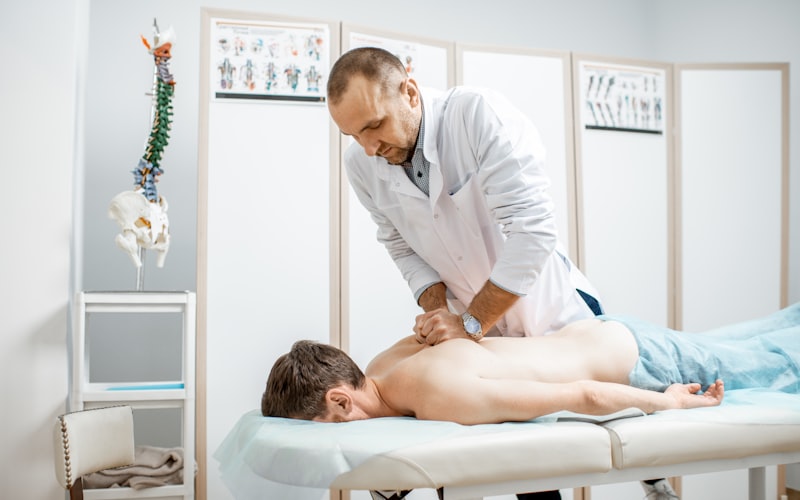
We use adjustments and mobilization to restore proper motion not just to the knee, but to the hip, ankle, and foot. Improving motion in these neighboring joints reduces the abnormal load that the knee has been absorbing.
Gait and Alignment Analysis
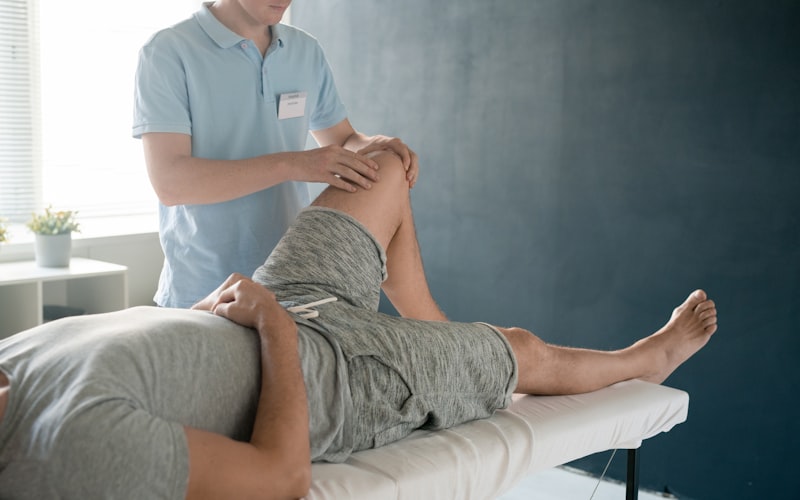
Through gait and posture analysis, we identify the mechanical faults loading your knee abnormally, overpronating feet, a weak hip on one side, a leg-length difference, or a movement pattern that grinds the joint. Correcting these changes how force travels through the knee with every step.
Soft Tissue Therapy
The muscles around an arthritic knee, the quadriceps, hamstrings, IT band, and calf, develop tightness and trigger points that add to pain and restrict motion. Soft tissue therapy relieves this component and improves how the joint moves.
Strengthening: The Most Important Piece
If there is one intervention with the strongest evidence for knee osteoarthritis, it is exercise, specifically strengthening the muscles that support and control the knee. Strong quadriceps and well-controlled hips act as shock absorbers and stabilizers, dramatically reducing the load and pain in an arthritic joint. We prescribe a progressive, individualized program, because generic exercises done incorrectly can aggravate the knee.
The Role of Weight and Load
This is uncomfortable to discuss but too important to skip: the forces across the knee during walking are several times body weight, and they climb higher with stairs and inclines. Even a modest reduction in body weight produces a disproportionately large reduction in knee load. For patients carrying extra weight, this is one of the highest-leverage things they can do, and we support it as part of a broader plan rather than lecturing about it.
When Surgery Makes Sense
I am not against knee replacement. For the right patient, an advanced, painful, function-limiting arthritic knee that has not responded to a real trial of conservative care, joint replacement is an excellent, life-changing operation. The point is sequencing. Conservative care first makes sense because it carries essentially none of the risks of surgery, it frequently provides meaningful relief, and even patients who eventually need surgery do better when they go in with stronger, better-functioning muscles. If your knee genuinely needs an orthopedic surgeon, we will tell you and help coordinate that care.
You Have Options
If knee pain or an arthritis diagnosis is shrinking your life, do not assume your only choices are pain pills or surgery. Contact Bromberg Chiropractic for an evaluation. We will assess your whole lower-limb mechanics, build a plan to reduce your pain and improve your function, and give you an honest assessment of what conservative care can do for your knee.